Comparisons
ShowingTime vs MLS-Native Showing Tools: What's Changing in 2026
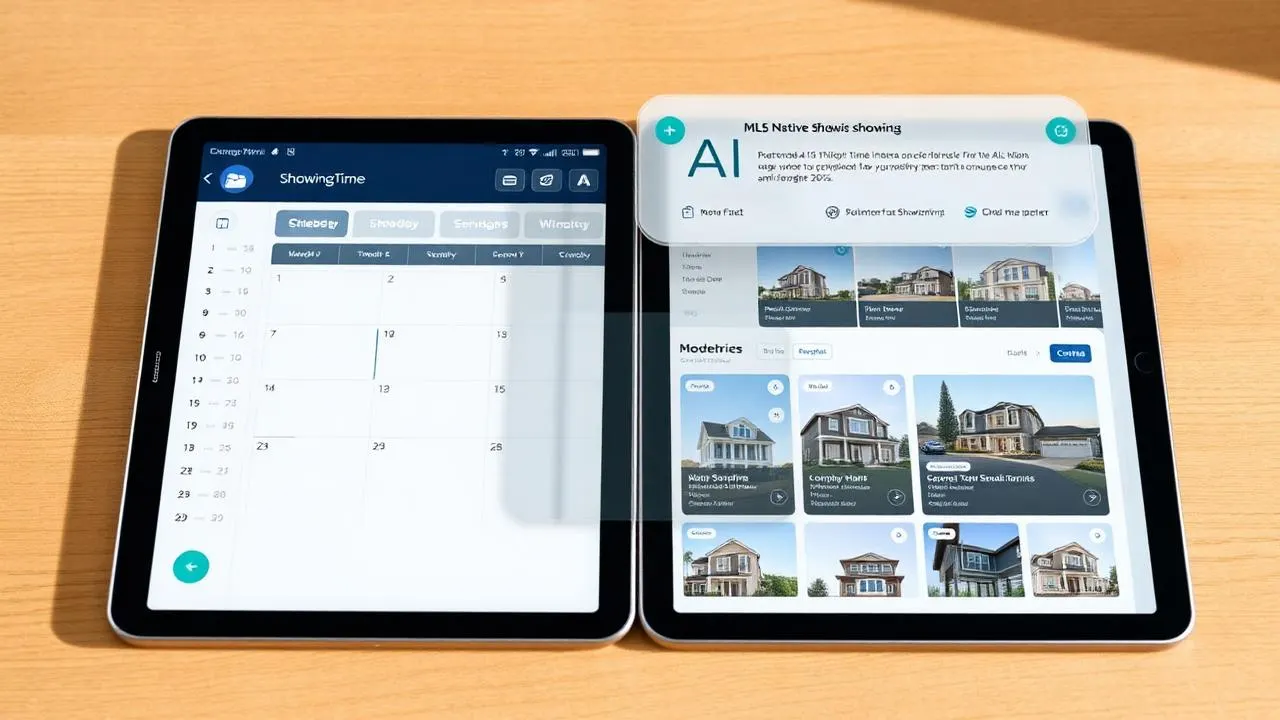
ShowingTime's product changes
Three shifts to be aware of.
Pricing model. ShowingTime's pricing has migrated toward MLS-bundled access rather than direct agent licensing in most markets. For listing agents whose MLS subsidizes the access, the per-agent cost is effectively zero — which is the strongest argument for staying. For listing agents whose MLS doesn't bundle or who are looking at the upcoming bundle renegotiations, the prices being quoted are noticeably higher than 2024.
Feature direction. Post-acquisition, ShowingTime's roadmap has emphasized integration with the broader Zillow ecosystem — Premier Agent, Zillow showing-request flow, and Zillow's lead-routing tools. For listing agents who already live in the Zillow ecosystem, this is a positive. For listing agents whose business is mostly off-Zillow (referrals, sphere, MLS-native traffic), the integration is irrelevant or worse — feature investment is being directed at problems they don't have.
Showing-management vs. showing-response split. ShowingTime has historically been strong at the calendaring and scheduling side: lockbox windows, agent availability, showing instructions. It has never been strong at the email-reply side — the actual NAR-compliant, commission-disclosing, audit-logged response to a showing request that comes in through a non-ShowingTime channel (Zillow direct, MLS-native portals, direct buyer-agent email). That gap was acceptable in 2022 when most showings came through ShowingTime. In 2026, with channels fragmenting, that gap is the problem.
For a deeper breakdown including the specific feature deltas, our full ShowingTime comparison goes long.
The MLS-native push
Multiple regional MLSs spent 2024 and 2025 building native showing-management tools as alternatives to ShowingTime. The trend accelerated through 2026.
CRMLS (the California Regional MLS, one of the largest in the US) has rolled out a native showing-coordination module that lives inside the MLS itself. Listing agents can manage availability, accept requests, and send showing instructions without leaving the MLS UI. The compliance disclosures specific to California are pre-loaded.
BrightMLS (covering the Mid-Atlantic — Maryland, Virginia, DC, Delaware, and parts of Pennsylvania and New Jersey) has launched a comparable native showing tool with regional disclosure pre-loading. The Mid-Atlantic agent base has been notably quick to adopt, partly because of regional discontent with the ShowingTime price changes.
Stellar MLS (Florida) is on a similar trajectory, with a native showing module that integrates directly into the Florida-specific compliance flow.
The advantage MLS-native tools have over ShowingTime: regional compliance is pre-loaded, the data lives in the MLS already, and the cost is bundled with MLS dues. The disadvantage: most MLS-native tools are weak on the reply-side workflow (template management, audit logging, multi-channel monitoring) and they don't help with showing requests that arrive through channels outside the MLS — which is most of them, for most listing agents.
Net: MLS-native tools have caught up on the calendaring side. The reply-side workflow is still where the gap is.
How to evaluate the alternatives
If you're a listing agent weighing options in 2026, these are the four questions worth asking.
1. What share of your showing requests actually come through ShowingTime vs. other channels? Pull a month of your inbox. Sort showing requests by source: ShowingTime, MLS-native, Zillow direct, direct buyer-agent email, Realtor.com. If ShowingTime is less than 40% of the volume, the calendaring win is smaller than it feels and the reply-side gap is bigger.
2. Does your MLS subsidize ShowingTime, or are you paying directly? If your MLS subsidizes, the marginal cost of keeping ShowingTime is zero and the decision is feature-only. If you're paying directly, the cost-benefit changes — the MLS-native alternative may be free with your dues.
3. What's your jurisdiction's compliance complexity? A listing agent in a high-complexity state (California, New York, Massachusetts) gets more value from MLS-native tools because the regional disclosures are pre-loaded. A listing agent in a low-complexity state gets less differential value from MLS-native vs. ShowingTime.
4. How fragmented is your inbound channel mix? If you get showings through five different channels, no single platform — ShowingTime or MLS-native — handles the full picture. You need an overlay that monitors all of them. This is where AI showing-response platforms come in.
The honest answer for most listing agents is "keep ShowingTime if it's free, supplement with an AI overlay for the reply-side gap." The overlay is where the real workflow leverage lives in 2026.
Where AI overlays add value
The reply-side gap is the structural opening. ShowingTime, MLS-native tools, and direct-email channels all have one thing in common: they generate a request that has to be replied to. That reply has to carry NAR-compliant commission disclosure, state-specific obligations, and an audit log. None of the calendaring tools do this well.
An AI showing-response overlay — a platform that sits on your inbox and replies to showing requests regardless of which channel they came from — does three things ShowingTime and MLS-native tools don't:
Multi-channel reply consistency. One reply template, applied uniformly across Zillow, ShowingTime, MLS-native, and direct-email requests. Uniform reply latency across requesters is your strongest fair-housing defense.
Compliance baked in. Commission disclosure, state-specific obligations, and template approval are managed in one place. Updates propagate to every channel automatically — including the new NAR settlement obligations that most calendaring tools still don't enforce on the reply.
Forensic-grade audit log. Every request-reply pair stored as an immutable record with timestamps. ShowingTime stores its own messages; MLS-native tools store their own; nothing else stores the inbound emails from Zillow, Realtor.com, or direct buyer-agent contact. An AI overlay stores all of them in one place.
This is the slot ShowSmartly fills. See how it sits next to whatever calendaring tool you're already using, or read the AI for realtors overview for the broader category context. The point isn't to replace ShowingTime or your MLS-native tool — it's to fill the reply-side gap neither of them fills well.
Quick comparison
| Capability | ShowingTime | MLS-Native | AI Showing-Response Overlay |
|---|---|---|---|
| Showing calendar / availability | Strong | Strong | No |
| Lockbox / access management | Strong | Good | No |
| Multi-channel inbound capture | Weak | Weak | Strong |
| NAR-compliant reply generation | Weak | Weak | Strong |
| State-specific disclosure auto-loading | Weak | Good | Strong |
| Audit-log retention (forensic-grade) | Good | Variable | Strong |
| Cost (typical) | Bundled or rising | Free with MLS dues | $10–$40/mo |
Frequently asked questions
Is ShowingTime still the best option for listing agents in 2026?
It depends on whether your MLS bundles it and how fragmented your inbound channels are. If ShowingTime is bundled with your MLS dues and most of your showings come through it, it's still a strong choice. If you're paying separately or your channels are fragmented, an MLS-native tool plus an AI overlay is often better.
What are the best ShowingTime alternatives in 2026?
For calendaring: the MLS-native tools (CRMLS, BrightMLS, Stellar MLS, and similar regional builds). For the reply-side workflow: AI showing-response platforms like ShowSmartly that monitor all your inbound channels at once.
Do I need to choose between ShowingTime and an MLS-native tool?
Many listing agents run both: ShowingTime for the cross-MLS coordination and the MLS-native tool for regional efficiency. They don't conflict. The bigger question is what handles the reply-side workflow that neither does well.
How much does an AI showing-response overlay cost in 2026?
$10 to $40 per month per agent. ShowSmartly is at $10/month, which is low enough that the payback on time savings is under a week for any active listing agent.
Fill the reply-side gap in a week
Keep ShowingTime or your MLS-native tool for calendaring. Add ShowSmartly for the NAR-compliant, multi-channel, audit-logged reply. Start a 3-month free trial — you'll know within a week if the $10 is worth it.
Start free trial